Adobe Prelude was an ingest and logging software application for tagging media with metadata for searching, post-production workflows, and footage lifecycle management. Adobe Prelude is also made to work closely with Adobe Premiere Pro. It is part of the Adobe Creative Cloud and is geared towards professional video editing alone or with a group. The software also offers features like rough cut creation. A speech transcription feature was removed in December 2014. == History == Adobe announced that on April 23, 2012 Adobe OnLocation would be shut down and Adobe Prelude would launch on May 7, 2012. Adobe stated OnLocation's production was stopping because of the growing trend in the industry toward tapeless, native workflows, Adobe stresses that Adobe Prelude is not a direct replacement for OnLocation. Adobe OnLocation was available in CS5 but not in CS6 and Adobe Prelude is only available in CS6. Adobe still offers technical support for OnLocation. In 2021, Adobe announced they would be discontinuing Adobe Prelude, starting by removing it from their website on September 8, 2021. Support for existing users will continue through September 8, 2024. == Features == Prelude is used to tag media, log data, create and export metadata and generate rough cuts that can be sent to Adobe Premiere Pro. A user can add a tag to a piece of media that will show up on Premiere Pro or if another user opens that media with Prelude. Ingest Footage Prelude can ingest all kinds of file types. Once ingested, Prelude can duplicate, transcode and verify the files. Log Footage Prelude can log data only using the keyboard. Create Rough Cuts Prelude is able to generate Rough Cuts. Rough Cuts are a combination of sub clips that will hold any metadata a user feeds into it. Rough cuts can hold metadata such as markers and comments, and this metadata will stay on this footage. Workflow Accessibility Prelude is an XMP - based open platform that allows for custom integration into many video editing platforms. == Features from OnLocation == Many features from Adobe OnLocation went to Adobe Prelude or Adobe Premiere Pro. Adobe OnLocation thrived on tape - based cameras and setting up a shot before shooting it, with the change in the industry, this problem is irrelevant in post production. Adobe OnLocation also allowed the user to add tags and scripting metadata that would carry over to Premiere Pro. OnLocation also had a Media Browser pane, which is the standard for any Adobe program today, Prelude has this Media Browser as well. == Prelude Live Logger == Prelude Live Logger is an application integrated with Prelude CC. Prelude Live Logger is designed to capture notes to use during video logging and editing while you shoot footage on an iPad's camera. Editors can import and combine this metadata with footage from Prelude throughout editing to facilitate various tasks.
Cognitive robotics
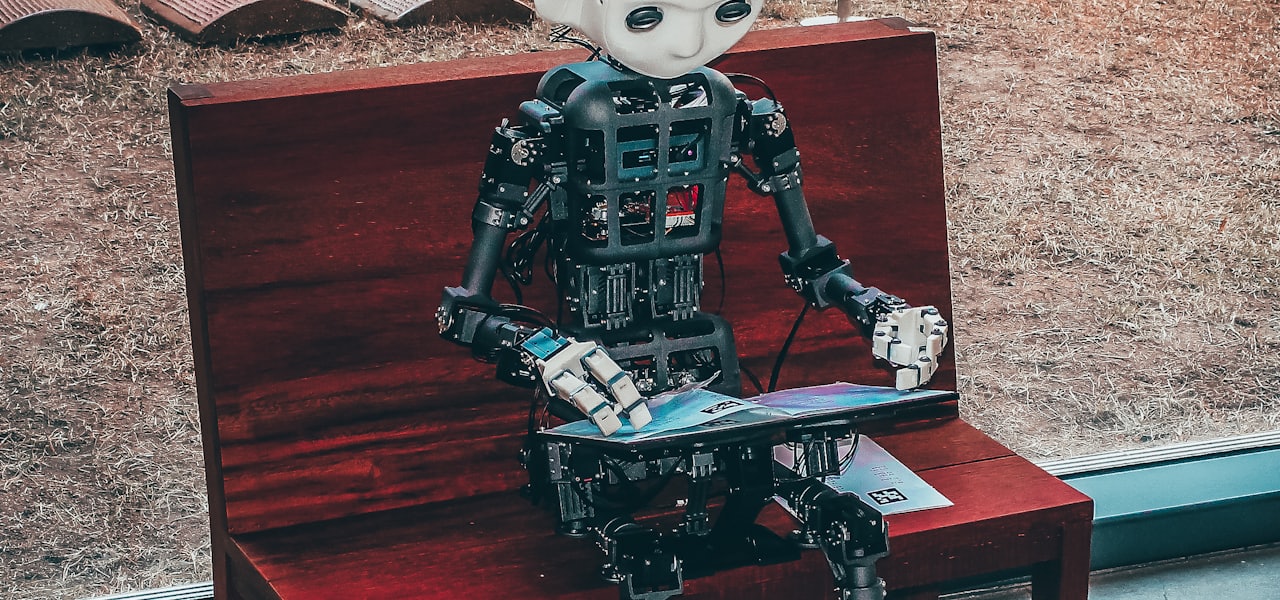
Cognitive robotics or cognitive technology is a subfield of robotics concerned with endowing a robot with intelligent behavior by providing it with a processing architecture that will allow it to learn and reason about how to behave in response to complex goals in a complex world. Cognitive robotics may be considered the engineering branch of embodied cognitive science and embodied embedded cognition, consisting of robotic process automation, artificial intelligence, machine learning, deep learning, optical character recognition, image processing, process mining, analytics, software development and system integration. == Core issues == While traditional cognitive modeling approaches have assumed symbolic coding schemes as a means for depicting the world, translating the world into these kinds of symbolic representations has proven to be problematic if not untenable. Perception and action and the notion of symbolic representation are therefore core issues to be addressed in cognitive robotics. == Starting point == Cognitive robotics views human or animal cognition as a starting point for the development of robotic information processing, as opposed to more traditional artificial intelligence techniques. Target robotic cognitive capabilities include perception processing, attention allocation, anticipation, planning, complex motor coordination, reasoning about other agents and perhaps even about their own mental states. Robotic cognition embodies the behavior of intelligent agents in the physical world (or a virtual world, in the case of simulated cognitive robotics). Ultimately, the robot must be able to act in the real world. == Learning techniques == === Motor Babble === A preliminary robot learning technique called motor babbling involves correlating pseudo-random complex motor movements by the robot with resulting visual and/or auditory feedback such that the robot may begin to expect a pattern of sensory feedback given a pattern of motor output. Desired sensory feedback may then be used to inform a motor control signal. This is thought to be analogous to how a baby learns to reach for objects or learns to produce speech sounds. For simpler robot systems, where, for instance, inverse kinematics may feasibly be used to transform anticipated feedback (desired motor result) into motor output, this step may be skipped. === Imitation === Once a robot can coordinate its motors to produce a desired result, the technique of learning by imitation may be used. The robot monitors the performance of another agent and then the robot tries to imitate that agent. It is often a challenge to transform imitation information from a complex scene into a desired motor result for the robot. Note that imitation is a high-level form of cognitive behavior and imitation is not necessarily required in a basic model of embodied animal cognition. === Knowledge acquisition === A more complex learning approach is "autonomous knowledge acquisition": the robot is left to explore the environment on its own. A system of goals and beliefs is typically assumed. A somewhat more directed mode of exploration can be achieved by "curiosity" algorithms, such as Intelligent Adaptive Curiosity or Category-Based Intrinsic Motivation. These algorithms generally involve breaking sensory input into a finite number of categories and assigning some sort of prediction system (such as an artificial neural network) to each. The prediction system keeps track of the error in its predictions over time. Reduction in prediction error is considered learning. The robot then preferentially explores categories in which it is learning (or reducing prediction error) the fastest. == Other architectures == Some researchers in cognitive robotics have tried using architectures such as (ACT-R and Soar (cognitive architecture)) as a basis of their cognitive robotics programs. These highly modular symbol-processing architectures have been used to simulate operator performance and human performance when modeling simplistic and symbolized laboratory data. The idea is to extend these architectures to handle real-world sensory input as that input continuously unfolds through time. What is needed is a way to somehow translate the world into a set of symbols and their relationships. == Questions == Some of the fundamental questions to be answered in cognitive robotics are: How much human programming should or can be involved to support the learning processes? How can one quantify progress? Some of the adopted ways are reward and punishment. But what kind of reward and what kind of punishment? In humans, when teaching a child, for example, the reward would be candy or some encouragement, and the punishment can take many forms. But what is an effective way with robots?
Algorithmic transparency
Algorithmic transparency is the principle that the factors that influence the decisions made by algorithms should be visible, or transparent, to the people who use, regulate, and are affected by systems that employ those algorithms. Although the phrase was coined in 2016 by Nicholas Diakopoulos and Michael Koliska about the role of algorithms in deciding the content of digital journalism services, the underlying principle dates back to the 1970s and the rise of automated systems for scoring consumer credit. The phrases "algorithmic transparency" and "algorithmic accountability" are sometimes used interchangeably – especially since they were coined by the same people – but they have subtly different meanings. Specifically, "algorithmic transparency" states that the inputs to the algorithm and the algorithm's use itself must be known, but they need not be fair. "Algorithmic accountability" implies that the organizations that use algorithms must be accountable for the decisions made by those algorithms, even though the decisions are being made by a machine, and not by a human being. Current research around algorithmic transparency interested in both societal effects of accessing remote services running algorithms, as well as mathematical and computer science approaches that can be used to achieve algorithmic transparency. In the United States, the Federal Trade Commission's Bureau of Consumer Protection studies how algorithms are used by consumers by conducting its own research on algorithmic transparency and by funding external research. In the European Union, the data protection laws that came into effect in May 2018 include a "right to explanation" of decisions made by algorithms, though it is unclear what this means. Furthermore, the European Union founded The European Center for Algorithmic Transparency (ECAT).
DIKW pyramid
The DIKW pyramid (also known as the knowledge pyramid or information hierarchy) is a model describing relationships between data, information, knowledge and wisdom sometimes also stylized as a chain, refer to models of possible structural and functional relationships between a set of components—often four, data, information, knowledge, and wisdom. The concept has roots predating the 1980s. In the latter years of that decade, interest in the models grew after explicit presentations and discussions, including from Milan Zeleny, Russell Ackoff, and Robert W. Lucky. Subsequent important discussions extended along theoretical and practical lines into the coming decades. While debate continues as to actual meaning of the component terms of DIKW-type models, and the actual nature of their relationships—including occasional doubt being cast over any simple, linear, unidirectional model—even so they have become very popular visual representations in use by business, the military, and others. Among the academic and popular, not all versions of the DIKW-type models include all four components (earlier ones excluding data, later ones excluding or downplaying wisdom, and several including additional components (for instance Ackoff inserting "understanding" before and Zeleny adding "enlightenment" after the wisdom component). In addition, DIKW-type models are no longer always presented as pyramids, instead also as a chart or framework (e.g., by Zeleny), as flow diagrams (e.g., by Liew, and by Chisholm et al.), and sometimes as a continuum (e.g., by Choo et al.). == Short description == As Rowley noted in 2007, the DIKW model "is often quoted, or used implicitly, in definitions of data, information and knowledge in the information management, information systems and knowledge management literatures, but [as of that date] there ha[d] been limited direct discussion of the hierarchy". Reviews of textbooks and a survey of scholars in relevant fields indicate that there was not a consensus as to definitions used in the model as of that date, and as reviewed by Liew in that year, even less "in the description of the processes that transform components lower in the hierarchy into those above them". Zins work, published in 2007—from studies in 2003-2005 that documented "130 definitions of data, information, and knowledge formulated by 45 scholars", published in 2007—to suggest that the data–information–knowledge components of DIKW refer to a class of no less than five models, as a function of whether data, information, and knowledge are each conceived of as subjective, objective (what Zins terms, "universal" or "collective") or both. In Zins' usage, subjective and objective "are not related to arbitrariness and truthfulness, which are usually attached to the concepts of subjective knowledge and objective knowledge". Information science, Zins argues, studies data and information, but not knowledge, as knowledge is an internal (subjective) rather than an external (universal–collective) phenomenon. == Representations == === Graphical representation === DIKW is a hierarchical model often depicted as a pyramid, sometimes as a chain, with data at its base and wisdom at its apex (or chain-beginning and -end). Both Zeleny and Ackoff have been credited with originating the pyramid representation, although neither used a pyramid to present their ideas. According to Wallace, Debons and colleagues may have been the first to "present the hierarchy graphically". Many variations of the DIKW-type pyramid have been produced. One, in use by knowledge managers in the United States Department of Defense, attempts to show the DIKW progression to enable effective decisions and consequent activities supporting shared understanding throughout defense organizations, as well as supporting management of risks associated with decisions. DIKW-type hierarchical information paradigms have also been represented as two-dimensional charts, and as flow diagrams, where relationships between the components may be presented less hierarchically, with defining aspects of the relationships, feedback loops, etc. === Computational representation === Intelligent decision support systems are trying to improve decision making by introducing new technologies and methods from the domain of modeling and simulation in general, and in particular from the domain of intelligent software agents in the contexts of agent-based modeling. The following example describes a military decision support system, but the architecture and underlying conceptual idea are transferable to other application domains: The value chain starts with data quality describing the information within the underlying command and control systems. Information quality tracks the completeness, correctness, currency, consistency and precision of the data items and information statements available. Knowledge quality deals with procedural knowledge and information embedded in the command and control system such as templates for adversary forces, assumptions about entities such as ranges and weapons, and doctrinal assumptions, often coded as rules. Awareness quality measures the degree of using the information and knowledge embedded within the command and control system. Awareness is explicitly placed in the cognitive domain. By the introduction of a common operational picture, data are put into context, which leads to information instead of data. The next step, which is enabled by service-oriented web-based infrastructures (but not yet operationally used), is the use of models and simulations for decision support. Simulation systems are the prototype for procedural knowledge, which is the basis for knowledge quality. Finally, using intelligent software agents to continually observe the battle sphere, apply models and simulations to analyze what is going on, to monitor the execution of a plan, and to do all the tasks necessary to make the decision maker aware of what is going on, command and control systems could even support situational awareness, the level in the value chain traditionally limited to pure cognitive methods. == History == Danny P. Wallace, a professor of library and information science, explained that the origin of the DIKW pyramid is uncertain: The presentation of the relationships among data, information, knowledge, and sometimes wisdom in a hierarchical arrangement has been part of the language of information science for many years. Although it is uncertain when and by whom those relationships were first presented, the ubiquity of the notion of a hierarchy is embedded in the use of the acronym DIKW as a shorthand representation for the data-to-information-to-knowledge-to-wisdom transformation.Many authors think that the idea of the DIKW relationship originated from two lines in the poem "Choruses", by T. S. Eliot, that appeared in the pageant play The Rock, in 1934: === Knowledge, intelligence, and wisdom === In 1927, Clarence W. Barron addressed his employees at Dow Jones & Company on the hierarchy: "Knowledge, Intelligence and Wisdom". === Data, information, knowledge === In 1955, English-American economist and educator Kenneth Boulding presented a variation on the hierarchy consisting of "signals, messages, information, and knowledge". However, "[t]he first author to distinguish among data, information, and knowledge and to also employ the term 'knowledge management' may have been American educator Nicholas L. Henry", in a 1974 journal article. === Data, information, knowledge, wisdom === Other early versions (prior to 1982) of the hierarchy that refer to a data tier include those of Chinese-American geographer Yi-Fu Tuan and sociologist-historian Daniel Bell.. In 1980, Irish-born engineer Mike Cooley invoked the same hierarchy in his critique of automation and computerization, in his book Architect or Bee?: The Human / Technology Relationship. Thereafter, in 1987, Czechoslovakia-born educator Milan Zeleny mapped the components of the hierarchy to knowledge forms: know-nothing, know-what, know-how, and know-why. Zeleny "has frequently been credited with proposing the [representation of DIKW as a pyramid ]... although he actually made no reference to any such graphical model." The hierarchy appears again in a 1988 address to the International Society for General Systems Research, by American organizational theorist Russell Ackoff, published in 1989. Subsequent authors and textbooks cite Ackoff's as the "original articulation" of the hierarchy or otherwise credit Ackoff with its proposal. Ackoff's version of the model includes an understanding tier (as Adler had, before him), interposed between knowledge and wisdom. Although Ackoff did not present the hierarchy graphically, he has also been credited with its representation as a pyramid. In 1989, Bell Labs veteran Robert W. Lucky wrote about the four-tier "information hierarchy" in the form of a pyramid in his book Silicon Dreams. In the same year as Ackoff presented his a
Data management plan
A data management plan or DMP is a formal document that outlines how data are to be handled both during a research project, and after the project is completed. The goal of a data management plan is to consider the many aspects of data management, metadata generation, data preservation, and analysis before the project begins; this may lead to data being well-managed in the present, and prepared for preservation in the future. DMPs were originally used in 1966 to manage aeronautical and engineering projects' data collection and analysis, and expanded across engineering and scientific disciplines in the 1970s and 1980s. Up until the early 2000s, DMPs were used "for projects of great technical complexity, and for limited mid-study data collection and processing purposes". In the 2000s and later, E-research and economic policies drove the development and uptake of DMPs. == Importance == Preparing a data management plan before data are collected is claimed to ensure that data are in the correct format, organized well, and better annotated. This could arguably save time in the long term because there is no need to re-organize, re-format, or try to remember details about data. It is also claimed to increase research efficiency since both the data collector and other researchers might be able to understand and use well-annotated data in the future. One component of a data management plan is data archiving and preservation. By deciding on an archive ahead of time, the data collector can format data during collection to make its future submission to a database easier. If data are preserved, they are more relevant since they can be re-used by other researchers. It also allows the data collector to direct requests for data to the database, rather than address requests individually. A frequent argument in favor of preservation is that data that are preserved have the potential to lead to new, unanticipated discoveries, and they prevent duplication of scientific studies that have already been conducted. Data archiving also provides insurance against loss by the data collector. In the 2010s, funding agencies increasingly required data management plans as part of the proposal and evaluation process, despite little or no evidence of their efficacy. == Major components == "There is no general and definitive list of topics that should be covered in a DMP for a research project", and researchers are often left to their own devices as to how to fill out a DMP. === Information about data and data format === A description of data to be produced by the project. This might include (but is not limited to) data that are: Experimental Observational Raw or derived Physical collections Models Simulations Curriculum materials Software Images How will the data be acquired? When and where will they be acquired? After collection, how will the data be processed? Include information about Software used Algorithms Scientific workflows File formats that will be used, justify those formats, and describe the naming conventions used. Quality assurance & quality control measures that will be taken during sample collection, analysis, and processing. If existing data are used, what are their origins? How will the data collected be combined with existing data? What is the relationship between the data collected and existing data? How will the data be managed in the short-term? Consider the following: Version control for files Backing up data and data products Security & protection of data and data products Who will be responsible for management === Metadata content and format === Metadata are the contextual details, including any information important for using data. This may include descriptions of temporal and spatial details, instruments, parameters, units, files, etc. Metadata is commonly referred to as "data about data". Issues to be considered include: How detailed has the metadata to be in order to make the data meaningful? How will the metadata be created and/or captured? Examples include lab notebooks, GPS hand-held units, Auto-saved files on instruments, etc. What format will be used for the metadata? What are the metadata standards commonly used in the respective scientific discipline? There should be justification for the format chosen. === Policies for access, sharing, and re-use === Describe any obligations that exist for sharing data collected. These may include obligations from funding agencies, institutions, other professional organizations, and legal requirements. Include information about how data will be shared, including when the data will be accessible, how long the data will be available, how access can be gained, and any rights that the data collector reserves for using data. Address any ethical or privacy issues with data sharing Address intellectual property & copyright issues. Who owns the copyright? What are the institutional, publisher, and/or funding agency policies associated with intellectual property? Are there embargoes for political, commercial, or patent reasons? Describe the intended future uses/users for the data Indicate how the data should be cited by others. How will the issue of persistent citation be addressed? For example, if the data will be deposited in a public archive, will the dataset have a persistent identifier (e.g., ARK, DOI, Handle, PURL, URN) assigned to it? === Long-term storage and data management === Researchers should identify an appropriate archive for the long-term preservation of their data. By identifying the archive early in the project, the data can be formatted, transformed, and documented appropriately to meet the requirements of the archive. Researchers should consult colleagues and professional societies in their discipline to determine the most appropriate database, and include a backup archive in their data management plan in case their first choice goes out of existence. Early in the project, the primary researcher should identify what data will be preserved in an archive. Usually, preserving the data in its most raw form is desirable, although data derivatives and products can also be preserved. An individual should be identified as the primary contact person for archived data, and ensure contact information is always kept up-to-date in case there are requests for data or information about data. === Budget === Data management and preservation costs may be considerable, depending on the nature of the project. By anticipating costs ahead of time, researchers ensure that the data will be properly managed and archived. Potential expenses that should be considered are Human resources and staff as they handle data preparation, management, documentation, and preservation Hardware and/or software needed for data management, backing up, security, documentation, and preservation Costs associated with submitting the data to an archive The data management plan should include how these costs will be paid. == NSF Data Management Plan == All grant proposals submitted to National Science Foundation (NSF) must include a Data Management Plan that is no more than two pages. This is a supplement (not part of the 15-page proposal) and should describe how the proposal will conform to the Award and Administration Guide policy (see below). It may include the following: The types of data The standards to be used for data and metadata format and content Policies for access and sharing Policies and provisions for re-use Plans for archiving data Policy summarized from the NSF Award and Administration Guide, Section 4 (Dissemination and Sharing of Research Results): Promptly publish with appropriate authorship Share data, samples, physical collections, and supporting materials with others, within a reasonable time frame Share software and inventions Investigators can keep their legal rights over their intellectual property, but they still have to make their results, data, and collections available to others Policies will be implemented via Proposal review Award negotiations and conditions Support/incentives == ESRC Data Management Plan == Since 1995, the UK's Economic and Social Research Council (ESRC) have had a research data policy in place. The current ESRC Research Data Policy states that research data created as a result of ESRC-funded research should be openly available to the scientific community to the maximum extent possible, through long-term preservation and high-quality data management. ESRC requires a data management plan for all research award applications where new data are being created. Such plans are designed to promote a structured approach to data management throughout the data lifecycle, resulting in better quality data that is ready to archive for sharing and re-use. The UK Data Service, the ESRC's flagship data service, provides practical guidance on research data management planning suitable for social science researchers in the UK and around the world. ESRC has a longstanding arrangement with the UK Data A
Wunderlist
Wunderlist is a discontinued cloud-based task management application. It allowed users to create lists to manage their tasks from a smartphone, tablet, computer and smartwatch. Wunderlist was free; additional collaboration features were available in a paid version known as Wunderlist Pro, released April 2013. Wunderlist was created in 2011 by Berlin-based startup 6Wunderkinder (Engl.: 6Prodigies). The company was acquired by Microsoft in June 2015, at which time the app had over 13 million users. In April 2017, Microsoft announced that Wunderlist would eventually be discontinued in favor of Microsoft To Do, a new multi-platform app developed by the Wunderlist team that has direct integration with the company's Office 365 service. On December 6, 2019, Microsoft announced that it would shut down Wunderlist on May 6, 2020. After this date, the application would no longer sync but users could still import their content into Microsoft To Do. == History == In 2009, Wunderlist's CEO Christian Reber called on the social network platform XING for business partners to create a new to-do app. Frank Thelen responded and together Reber and Thelen developed first concepts for Wunderlist. The necessary seed funding was granted by High-Tech Gründerfonds and e42 GmbH. The first version of Wunderlist was launched on November 9, 2010. Initially, the program was created for desktop PCs and platforms such as Windows, Linux and Mac OS X. In December 2011, the app received approval for the iPhone. Subsequently, the developers released a version prepared for the iPad with the name Wunderlist HD. In September 2012, the developers announced a shutdown of their service Wunderkit. Instead they wanted to focus on creating a new version of Wunderlist, which was later on released in December 2012 under the name Wunderlist 2. In September 2013, the company announced it had over 5 million users. In July 2014, a new major update was released under the name of Wunderlist 3, with a new real-time sync architecture. Wunderlist reached 10 million users in December 2014. On June 1, 2015, it was announced that Microsoft had acquired 6Wunderkinder, makers of Wunderlist, for between US$100 million and US$200 million (~$258 million in 2024). Following its acquisition of the app, Microsoft announced in April 2017 a preview of To-Do, a multi-platform task management app developed by the Wunderlist team that was intended to eventually replace Wunderlist and incorporate most of its features. As of January 2019, To-Do had not yet reached feature parity with Wunderlist, with its team citing that the service had to be completely re-written to use Microsoft Azure instead of Amazon Web Services. Frustrated by the perceived lack of roadmap, in September 2019, Reber began to publicly ask Microsoft-related accounts on Twitter whether he could buy Wunderlist back. Shortly afterward, however, Microsoft unveiled updates to To-Do that make it more closely resemble Wunderlist. In December 2019, Microsoft announced that it would fully shut down Wunderlist as of May 6, 2020. The team responsible for creating Wunderlist, led by co-founder Christian Reber, created that Superlist app in early 2024. == Finances == In its initial round of funding, 100,000 euro was invested in 6Wunderkinder by Frank Thelen and others. In December 2010, High-Tech Gründerfonds invested 500,000 euro (approximately US$660,000) in the company. T-Venture also invested an undisclosed amount in the startup. In its Series A round of funding in November 2011, Atomico invested $4.2 million (~$5.76 million in 2024) while High-Tech Gründerfonds invested an undisclosed additional amount. In May 2012, High-Tech Gründerfonds sold off its stake in 6Wunderkinder to Earlybird Venture Capital. In November 2013, $19 million (~$25.2 million in 2024) was raised in a Series B round led by Sequoia Capital with participation from Earlybird and Atomico. == Awards == In 2013, Wunderlist for Mac was named App of the Year. Wunderlist was selected as a Google Play Top Developer in 2013. In 2014, Wunderlist won the "Golden Mi" award from Xiaomi, and also named as one of its Best Apps of 2014 was given a "Google Play Editor's Choice" award, and was named in Google Play's Best Apps of 2014 as well as Apple's Best of 2014.
Uncertain database
An uncertain database is a kind of database studied in database theory. The goal of uncertain databases is to manage information on which there is some uncertainty. Uncertain databases make it possible to explicitly represent and manage uncertainty on the data, usually in a succinct way. == Formal definition == At the basis of uncertain databases is the notion of possible world. Specifically, a possible world of an uncertain database is a (certain) database which is one of the possible realizations of the uncertain database. A given uncertain database typically has more than one, and potentially infinitely many, possible worlds. A formalism to represent uncertain databases then explains how to succinctly represent a set of possible worlds into one uncertain database. == Types of uncertain databases == Uncertain database models differ in how they represent and quantify these possible worlds: Incomplete databases are a compact representation of the set of possible worlds – the use of NULL in SQL, arguably the most commonplace instantiation of uncertain databases, is an example of incomplete database model. Probabilistic databases are a compact representation of a probability distribution over the set of possible worlds. Fuzzy databases are a compact representation of a fuzzy set of the possible worlds. Though mostly studied in the relational setting, uncertain database models can also be defined in other relational models such as graph databases or XML databases. === Incomplete database === The most common database model is the relational model. Multiple incomplete database models have been defined over the relational model, that form extensions to the relational algebra. These have been called Imieliński–Lipski algebras: Relations with NULL values, also called Codd tables c-tables v-tables === Example === The following table is a relation of an incomplete database, described in the formalism of NULL values: There are infinitely many possible worlds for this incomplete database, obtained by replacing the "NULL" values with concrete values. For instance, the following relation is a possible world: